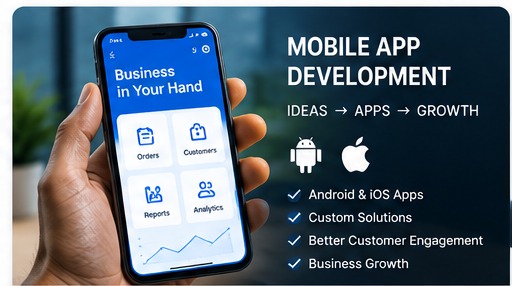
Mobile apps are used across many industries for customer services, employee workflows, online shopping, communication, bookings, payments, business operations and automation. A well-planned application can provide a convenient way for users to access services and information.
However, building a successful mobile app requires more than creating screens and publishing an application. The project should start with understanding the business problem, target users and expected outcome.
What Is Mobile App Development?
Mobile app development is the process of designing, developing, testing and deploying applications for mobile devices such as smartphones and tablets.
Depending on the project, an application may be developed for Android, iOS or multiple platforms using native or cross-platform technologies. The appropriate approach depends on the application's features, performance requirements, budget and long-term plans.
Why Businesses Build Mobile Apps
Businesses may develop mobile applications to provide customers with convenient access to products and services or to improve internal operations.
- Customer shopping and eCommerce applications
- Employee and telecaller applications
- Booking and appointment systems
- Delivery and logistics applications
- CRM and sales applications
- Inventory and business management apps
- Customer loyalty applications
- Communication and notification systems
- Business automation applications
1. Define the Purpose of the Mobile App
Before contacting a mobile app development company, clearly define the problem the application should solve. A clear purpose helps determine the required features, users and technical approach.
Ask questions such as:
- Who will use the application?
- What problem should the app solve?
- Which tasks should users complete?
- Does the app need a backend system?
- Does it need payments or third-party integrations?
- Will the app be used internally or by customers?
2. Identify Your Target Users
User requirements should influence the app design. A customer-facing shopping application will have different navigation and features from an employee attendance or business management application.
Identify the main user groups and understand what each group needs to accomplish through the app. This can help the development team plan user roles, permissions and workflows.
3. Choose the Right Development Approach
Mobile applications can be built using native development or cross-platform frameworks. The right choice depends on the project requirements rather than one technology being suitable for every app.
Discuss expected performance, device features, development requirements, maintenance and future expansion before selecting the technology stack.
4. Focus on UI/UX Design
Mobile users interact with smaller screens, so the interface should be simple and easy to navigate. Important actions should be clear and the application should avoid unnecessary complexity.
A mobile app development project may include wireframes, user flows, visual design, interactive prototypes and responsive layouts for different screen sizes.
5. Check the Development Company's Experience
Review previous applications developed by the company. Look for projects that have similar functionality or business requirements to yours.
Ask about experience with customer applications, employee applications, eCommerce, APIs, notifications, payments, dashboards and other features relevant to your project.
6. Understand Backend and API Requirements
Many business mobile apps need a backend to manage users, products, orders, notifications, reports and other data. The mobile application may communicate with the backend through APIs.
Ask how the mobile app will connect with your existing website, ERP, CRM, inventory system or other business software if integration is required.
7. Consider Security
Mobile applications may process customer information, employee data, transactions and other business information. Security should therefore be considered during both application and backend development.
Discuss authentication, user permissions, secure API communication, session management, data protection, backups and other security requirements relevant to the application.
8. Plan App Testing
Testing is important because mobile devices have different screen sizes, operating system versions and hardware capabilities. The application should be tested across the devices and workflows relevant to the target users.
Testing may include functional testing, UI testing, API testing, performance testing, security checks and user acceptance testing.
9. Check App Store and Play Store Requirements
Publishing a mobile application requires appropriate store accounts, application information, screenshots, icons, privacy information and compliance with the applicable store requirements.
Ask the development team whether app deployment and store submission are included in the project scope and who will manage the required developer accounts.
10. Understand the Complete Development Cost
Mobile app development costs depend on features, design complexity, backend requirements, integrations, platforms and development effort. The initial quotation may not represent every future cost.
Review whether the proposal includes:
- UI/UX design
- Android development
- iOS development
- Backend and API development
- Database setup
- Third-party integrations
- Testing and bug fixing
- Store deployment
- Maintenance and support
11. Ask About Post-Launch Support
A mobile application may need updates after launch because of operating system changes, new business requirements, security updates or customer feedback.
Before starting the project, ask how maintenance, bug fixing, version updates and future feature development will be handled.
12. Consider Scalability
A successful application may grow from a small user base to many customers or employees. The backend and application architecture should be planned with the expected growth in mind.
Discuss future requirements such as additional user roles, locations, products, modules, notifications, reports and integrations.
Common Types of Mobile Applications
Different businesses can use mobile applications for different purposes. Common examples include:
- eCommerce Apps: Product browsing, cart, checkout and order tracking.
- Business Apps: Sales, inventory, CRM and operational workflows.
- Employee Apps: Attendance, tasks, communication and internal processes.
- Booking Apps: Appointments, schedules and service bookings.
- Delivery Apps: Orders, delivery status and location-based workflows.
- Customer Apps: Services, notifications, accounts and support.
Native vs Cross-Platform Mobile Development
Native development focuses on building applications specifically for an operating system. Cross-platform development can allow businesses to share a significant portion of application code across supported platforms.
The appropriate approach depends on the project. Factors such as device features, performance, development requirements, maintenance and budget should be considered before making the decision.
Questions to Ask a Mobile App Development Company
- Have you developed apps similar to our requirement?
- Which platforms will the application support?
- Which technology stack do you recommend and why?
- Will the project include backend and API development?
- Can the app integrate with our existing software?
- How will UI/UX design and user testing be handled?
- How will application security be managed?
- How will testing be performed across devices?
- Is Play Store and App Store deployment included?
- What support is available after the application is launched?
Mobile App Development for Businesses in Coimbatore
Businesses in Coimbatore across retail, manufacturing, textiles, education, healthcare, services, logistics and other industries can use mobile applications for customer services and internal operations.
The application should be planned around the business workflow. For example, a retail app may focus on products and orders, while an employee application may focus on attendance, tasks and communication.
If you are planning a mobile application, our mobile app development services in Coimbatore can be used to discuss application strategy, UI/UX, development, APIs, integrations and deployment.
How to Start a Mobile App Project
Begin by documenting the application's purpose, users, main workflows and required features. Separate essential features from features that can be added later.
- Define the business problem.
- Identify target users.
- List the required features.
- Map the main user journeys.
- Identify backend and integration requirements.
- Plan the UI/UX.
- Select the development approach.
- Develop and test the application.
- Deploy to the required platforms.
- Monitor, maintain and improve the application.
Why Mobile App Planning Matters
Planning before development can help identify missing requirements, unnecessary features and integration challenges. It also gives the development team a clearer understanding of what the application needs to accomplish.
A practical mobile app project should balance user experience, functionality, security, performance, development effort and future maintenance.
Looking for Mobile App Development in Coimbatore?
Error Tech Solutions provides mobile app development solutions for businesses, including customer apps, employee applications, business applications, API integrations and custom mobile workflows.
Explore our Mobile App Development services or learn more about our Software Development services .
Planning a Mobile Application?
Tell us about your users, business workflow and required features. Our team can discuss a suitable mobile application and technology approach for your business.
Contact Error Tech Solutions